You finish a challenging workout feeling strong, accomplished, and maybe even surprised by how good your body feels. Then the next morning arrives.
Your legs feel heavy. Sitting down suddenly requires strategy. Walking downstairs feels like a workout of its own.
Even more confusing, you may feel more sore 24 or 48 hours after exercising than you did immediately after leaving the gym.
If that sounds familiar, you may be experiencing delayed onset muscle soreness, commonly known as DOMS.
DOMS is a normal response that can occur after exercise your muscles are not accustomed to. It is especially common after increasing workout intensity, returning to exercise after time away, or performing movements that place unfamiliar demands on your muscles.
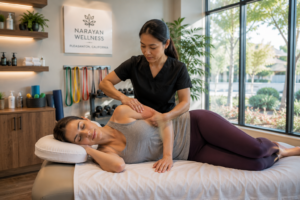
Although DOMS usually improves on its own, the stiffness and tenderness can make everyday movement uncomfortable. That is why active adults often explore recovery strategies such as gentle movement, appropriate rest, sleep, hydration, stretching, and massage.
Research suggests that massage for delayed onset muscle soreness (DOMS) may help reduce the perception of post-exercise soreness, although it should not be viewed as a shortcut that instantly repairs muscles or automatically improves athletic performance. A systematic review and meta-analysis of sports massage found a small but statistically significant improvement in DOMS while finding no evidence that massage directly improved strength, sprinting, jumping, endurance, or fatigue.
Understanding that distinction can help you recover more intelligently.
Why Are Your Muscles Sore Days After a Workout?
The delay is what makes post-workout soreness so confusing.
If something hurt during your workout, you would naturally connect the discomfort to what you were doing. DOMS behaves differently. You might finish exercising with little discomfort and wake up the following day wondering why your thighs, glutes, calves, shoulders, or arms suddenly feel so tender.
This delayed reaction is one of the defining characteristics of DOMS.
The discomfort usually develops after a demanding or unfamiliar exercise session rather than appearing as an immediate sharp pain during a particular movement. You may notice tenderness when pressing on the affected muscles, temporary stiffness, a reduced comfortable range of motion, or discomfort when using those muscles.
Think of it as your body responding to a workload that exceeded what those tissues were currently accustomed to.
That does not necessarily mean your workout was dangerous or that something went wrong. It also does not mean that extreme soreness is required for exercise to be effective.
What Is Delayed Onset Muscle Soreness (DOMS)?
Delayed onset muscle soreness is the muscle discomfort and stiffness that can develop after strenuous or unfamiliar physical activity.
A common misconception is that post-workout soreness comes primarily from lactic acid remaining trapped in your muscles. That explanation does not accurately describe DOMS.
Current understanding instead connects DOMS with the physiological response to unfamiliar or demanding exercise and microscopic exercise-related changes within muscle tissue. The resulting repair and inflammatory processes contribute to the soreness and stiffness you notice later.
That distinction matters.
DOMS is not simply something that needs to be “flushed out.” Recovery is a biological process that takes time.
Massage may help you feel more comfortable during that process, but it does not press a magical reset button on exercised muscles.
Why Does DOMS Often Feel Worse Two Days After Exercise?
DOMS can feel surprisingly mild immediately after exercise and noticeably stronger later.
That is because the response develops over time. Your body begins responding to the demands placed on the muscle after the workout has ended, so soreness may become more noticeable during the following day or two.
This explains a classic gym experience:
You do squats on Monday.
Tuesday morning, your legs feel a little stiff.
By Wednesday, stairs have become your least favorite architectural invention.
The delayed nature of DOMS is also why people sometimes assume that sleeping in the wrong position or another activity caused their discomfort. In reality, the unfamiliar workout from a day or two earlier may be responsible.
The good news is that ordinary DOMS is generally temporary. As recovery progresses, soreness should trend toward improvement.
What Types of Workouts Are Most Likely to Cause DOMS?
Almost any challenging exercise can cause DOMS when your body is not accustomed to it, but certain situations make it especially common.
Starting a New Exercise Program
Your first few sessions after a long break may produce considerable soreness because your muscles are adapting to movements and workloads they have not recently experienced.
Even someone who is generally fit can develop DOMS when switching activities. A cyclist might be extremely fit on a bike yet become surprisingly sore after a first strength-training session.
Increasing Training Intensity
Adding weight, repetitions, distance, hills, speed, or total training volume can create a larger-than-usual challenge.
You do not necessarily need an entirely new workout. Sometimes simply doing much more than usual is enough.
Eccentric Muscle Actions
DOMS is particularly associated with exercise involving substantial eccentric muscle action. This occurs when a muscle produces force while lengthening.
Examples include lowering a weight during a biceps curl, descending stairs or hills, lowering yourself during a squat, or controlling the downward phase of a push-up.
Imagine your muscles functioning like brakes. They are still working hard even though the movement looks like the “easy” half of the exercise.
Returning After Time Away
Vacation, illness, a busy work period, or simply falling out of your normal routine can reduce your recent training exposure.
When you return at your old intensity immediately, your muscles may respond as if the workout is relatively unfamiliar.
This is one reason gradual progression can be more comfortable than trying to make up for several missed weeks in one session.
DOMS vs. Injury: How Can You Tell the Difference?
This is one of the most important distinctions to make before scheduling massage for sore muscles.
DOMS generally develops after exercise, affects the muscles that were challenged, and gradually improves as recovery progresses.
An injury can behave differently.
A sudden sharp pain during exercise, significant swelling, bruising, obvious weakness, inability to use a limb normally, joint instability, numbness, or worsening pain deserves more caution.
Location can offer another clue.
DOMS often feels relatively diffuse across a muscle or muscle group. Injury pain may be much more localized, particularly when a specific structure has been strained or damaged.
However, symptoms do not always fit neatly into categories. Massage therapists do not replace medical evaluation, and massage should not be used to “push through” an unexplained injury.
If you are unsure whether your discomfort is normal post-exercise soreness or an injury, particularly when symptoms are severe or unusual, seek assessment from an appropriate healthcare professional before attempting aggressive massage or returning to intense training.
Can Massage Help with Delayed Onset Muscle Soreness?
Research suggests that it can help reduce soreness for some people.
A systematic review and meta-analysis examining massage after strenuous exercise reported significantly lower soreness ratings among participants receiving massage compared with control conditions at 24, 48, and 72 hours after exercise.
Another systematic review and meta-analysis involving 29 eligible studies and 1,012 participants found that massage was associated with a small but statistically significant improvement in DOMS. However, researchers found no evidence that sports massage directly improved strength, sprint, endurance, jumping, or fatigue measures.
That provides an important reality check.
Massage can be useful without needing to be presented as a miracle recovery tool.
A more accurate way to think about post-workout massage is that it may help make the recovery period feel more comfortable, decrease perceived soreness, support relaxation, and help restore a sense of comfortable movement.
It does not mean your muscles have instantly completed their biological recovery.
How Massage May Support Post-Workout Recovery
People often describe recovery massage as helping them feel looser and less guarded after demanding exercise. Several factors may contribute to that experience.
Reducing the Perception of Soreness
This is one of the better-supported reasons to consider massage after exercise.
Research has repeatedly investigated massage for DOMS, with systematic reviews finding reductions in perceived soreness even when objective performance improvements are limited.
That matters because soreness itself can affect how comfortably you move through your day.
Supporting Relaxation
Hard training is a stressor.
That stress is intentional, you challenge the body so it can adapt, but recovery requires a different environment than training.
Massage can provide a period in which you are not lifting, running, working, checking your phone, or thinking about your next interval. For many people, that shift into relaxation is valuable in its own right.
Helping You Feel More Comfortable Moving
Sore muscles often cause people to move cautiously.
You may shorten your stride, avoid bending deeply, or hold a sore shoulder differently without consciously realizing it.
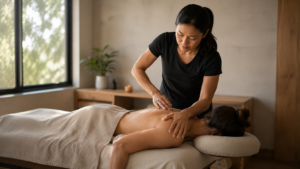
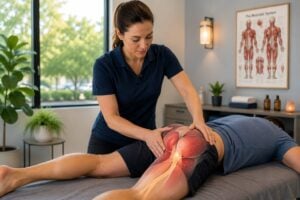
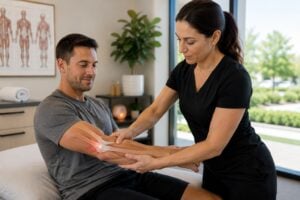
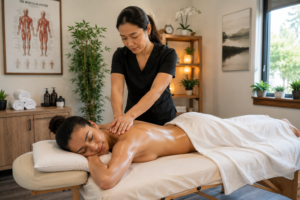
A carefully adjusted massage session may reduce the feeling of tightness and help movement feel more comfortable. Narayan Wellness offers multiple massage and bodywork options, including sports massage, deep tissue massage, myofascial release, trigger point massage, percussion massage, and full body stretch, allowing sessions to be tailored to individual needs.
When Should You Get a Massage After a Workout?
There is no universal rule saying everyone must wait exactly 24 or 48 hours.
The appropriate timing depends on the workout, your soreness, your health, your training schedule, and the type of massage being considered.
If you have just completed an especially demanding workout, aggressive pressure on already tender muscles may not be what your body needs.
This is where communication matters.
Tell your massage therapist what you did, when you trained, which muscles are sore, how intense the soreness feels, and whether anything feels unusual.
A recovery-focused session can then be adjusted appropriately rather than assuming that deeper pressure always produces better results.
Recent evidence comparing post-exercise recovery strategies also emphasizes that recovery effects can depend on timing. A 2026 network meta-analysis found massage beneficial for DOMS immediately after exercise and at 24 hours in its analysis, while effects varied across later recovery windows.
The practical lesson is simple: recovery should be individualized rather than treated as a rigid formula.
Final Thoughts
If your muscles feel sore one or two days after a challenging workout, delayed onset muscle soreness may be the reason.
DOMS commonly follows unfamiliar or unusually demanding exercise. It can leave muscles tender, stiff, and temporarily uncomfortable, but ordinary DOMS generally improves as your body recovers and adapts.
And while soreness can feel like proof that you trained hard, more soreness does not necessarily mean a better workout.
The goal of training is adaptation and not maximizing discomfort.
Massage therapy can have a place in that recovery process. Research suggests that massage may reduce perceived DOMS after strenuous exercise, while evidence does not support treating massage as an automatic way to increase strength, endurance, sprint performance, or other athletic performance measures.
That is actually a more useful way to understand massage.
It does not need exaggerated promises to be valuable.
For someone whose muscles feel stiff and tender after exercise, an appropriately tailored massage may help make recovery more comfortable, promote relaxation, and help the body feel easier to move while its normal recovery processes continue.
Combine that with sensible training progression, sleep, nutrition, hydration, light movement when appropriate, and adequate recovery time, and you have a much more sustainable approach than simply trying to push through every ache.
Your workout challenges your body.
Your recovery gives it the opportunity to respond.
And learning to respect both sides of that equation can help you keep doing the activities you enjoy with greater consistency.
FAQs
Why am I more sore two days after working out?
You may be experiencing delayed onset muscle soreness, or DOMS. Unlike pain that occurs during an exercise, DOMS develops after unfamiliar or demanding physical activity and can become more noticeable during the following day or two.
Does massage help delayed onset muscle soreness?
Research suggests massage may reduce perceived soreness associated with DOMS. Systematic reviews have found improvements in post-exercise soreness, although massage should not be interpreted as a treatment that instantly repairs exercised muscles or guarantees better athletic performance.
Should I get a massage when my muscles are extremely sore?
Massage pressure and technique should be adjusted to your condition. Extremely tender muscles do not necessarily need extremely deep pressure. Tell your massage therapist about your workout, when the soreness began, and how intense it feels so the session can be adapted appropriately.
Is deep tissue massage good for DOMS?
Deep tissue techniques may be appropriate for some clients, but deeper pressure is not automatically better for DOMS. When muscles are particularly tender after strenuous exercise, a therapist may use more moderate techniques based on comfort and individual needs.
How long after working out should I get a massage?
There is no single timing rule that applies to everyone. Research has studied massage at several points during post-exercise recovery, and the best timing can depend on your workout, symptoms, recovery goals, and massage technique.