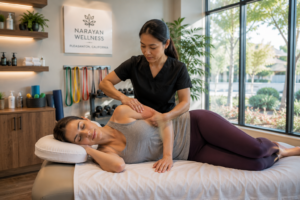
Shoulder pain has a way of making simple movements surprisingly complicated.
Reaching into a kitchen cabinet can hurt. Putting on a jacket becomes awkward. Sleeping on one side may wake you in the middle of the night. Even reaching behind your back or lifting a grocery bag can suddenly remind you how much you depend on your shoulders every day.
For many people, these problems involve the rotator cuff, a group of muscles and tendons that helps stabilize and move the shoulder.
Rotator cuff problems can develop gradually through repetitive use, age-related changes, sports, physical work, or poor movement patterns. They can also occur suddenly after an injury. Because several different conditions can produce similar shoulder symptoms, however, persistent shoulder pain should not automatically be assumed to be a tight muscle that simply needs deeper massage.
Massage therapy for rotator cuff pain is best understood as one possible component of a broader recovery strategy. Therapeutic bodywork may help address muscular tension, sensitivity, restricted movement, and compensation patterns surrounding a painful shoulder. It does not reconnect a torn tendon or replace appropriate medical care, physical therapy, or rehabilitation.
Understanding that distinction is the key to using massage safely and effectively.
What Is the Rotator Cuff?
Despite its name, the rotator cuff is not a single muscle.
It consists of four muscles and their tendons:
- Supraspinatus
- Infraspinatus
- Teres minor
- Subscapularis
Together, these structures help stabilize the head of the upper-arm bone within the shoulder socket while allowing the arm to rotate and move.
Think of the shoulder like a golf ball sitting on a relatively shallow tee. That design gives your arm tremendous freedom of movement, but it also means muscular control is essential for stability.
Your rotator cuff contributes to that control.
Every time you reach overhead, throw a ball, put your hand behind your back, lift something from a shelf, or rotate your arm, your shoulder depends on coordinated activity among the rotator cuff, shoulder blade, upper back, chest, neck, and arm muscles.
That interconnected system explains why shoulder pain is rarely as simple as finding one sore spot and pressing on it.
Why Rotator Cuff Pain Develops
Rotator cuff-related shoulder pain can have several causes.
Some problems occur after a specific event, such as falling onto an outstretched arm or suddenly lifting something heavy. Others develop gradually after months or years of repetitive loading.
People who repeatedly work with their arms overhead may place considerable demand on the shoulder. The same can be true for swimmers, tennis and pickleball players, baseball players, weightlifters, construction workers, painters, landscapers, and people whose jobs require repetitive reaching.
Age also matters. Rotator cuff tendons can undergo degenerative changes over time, making rotator cuff problems more common as people get older.
But sports and heavy physical work aren’t the only contributors.
Long periods at a computer can influence shoulder mechanics too. When the upper back remains rounded and the shoulders stay forward for hours, muscles around the chest, neck, shoulder blade, and upper back may develop patterns of stiffness or overactivity.
That does not necessarily mean posture “causes” a rotator cuff injury. Human posture is far more adaptable than that. But movement habits, workload, strength, recovery, previous injury, and repetitive positions can all influence how the shoulder feels and functions.
Common Signs of a Rotator Cuff Problem
Rotator cuff symptoms vary depending on the tissue involved and the severity of the condition.
Common complaints can include:
- A dull ache deep in the shoulder
- Pain when lifting the arm
- Discomfort with overhead movements
- Pain while reaching behind the back
- Shoulder or arm weakness
- Reduced range of motion
- Difficulty performing sports or work activities
- Nighttime discomfort
- Pain when sleeping on the affected side
Some people experience a painful arc when raising the arm. Others mainly notice weakness or discomfort during a specific activity, such as serving a tennis ball or placing luggage in an overhead compartment.
Importantly, shoulder pain can also come from other structures.
Problems involving the neck, joints, biceps tendon, arthritis, adhesive capsulitis, or other conditions may produce symptoms that overlap with rotator cuff pain.
That is why massage therapists do not replace medical diagnosis.
If your symptoms are significant, persistent, worsening, associated with trauma, or include substantial weakness, an appropriate healthcare professional should evaluate the shoulder.
Rotator Cuff Pain vs. a Rotator Cuff Tear
This distinction matters enormously.
“Rotator cuff pain” does not automatically mean “torn rotator cuff.”
Rotator cuff-related shoulder pain can involve irritation, tendinopathy, altered loading, or other musculoskeletal factors without a complete tendon tear.
A rotator cuff tear means part or all of a tendon has separated from its normal attachment. Tears may be partial or full thickness and can occur gradually or suddenly.
Massage cannot reattach a torn tendon.
That is an important boundary for any responsible discussion of massage for rotator cuff injuries.
Massage may sometimes be incorporated into a broader care plan to address surrounding muscle tension or compensatory discomfort, but the structural injury itself requires appropriate evaluation and management.
Sudden arm weakness following an injury deserves prompt medical attention.
Why Massage and Rehabilitation Work Better as a Team
A shoulder that feels better after massage still needs the capacity to handle everyday demands.
That distinction separates temporary symptom relief from long-term function.
Massage is largely passive: the therapist applies the intervention while the client receives it.
Rehabilitation is active. Appropriate exercises can progressively develop strength, mobility, endurance, coordination, and confidence in movement.
For rotator cuff-related shoulder pain, exercise is an important component of conservative management.
Research examining manual therapy and exercise has produced mixed results. Some analyses suggest benefits from combining approaches, while other reviews have not found manual therapy plus exercise superior to exercise alone for certain outcomes.
The practical lesson is not that massage has no place.
It is that massage should not be marketed as a substitute for progressive rehabilitation.
A person may find massage useful for reducing muscular tension, feeling more comfortable, or managing compensatory soreness while continuing a professionally guided strengthening program.
Think of it like maintaining the road while rebuilding a bridge.
Massage may help make the surrounding route easier to navigate, but strengthening and rehabilitation are what help develop the capacity needed for repeated movement and loading.
Can You Massage a Torn Rotator Cuff?
This question deserves a clear answer.
Massage does not repair a torn rotator cuff tendon.
If you have a confirmed tear, massage may sometimes be appropriate for surrounding muscles as part of a larger treatment plan, but whether and when it should be used depends on the severity of the injury, symptoms, treatment plan, and guidance from your healthcare team.
Direct, aggressive pressure over an injured structure is not automatically beneficial.
If a rotator cuff tear resulted from an acute injury, or if you suddenly cannot lift your arm normally, seek medical evaluation before treating the problem as ordinary muscle tension.
For people recovering from rotator cuff surgery, timing is even more important.
Post-operative massage should only be introduced when appropriate for the surgical recovery plan and with clearance from the relevant healthcare professional.
When Massage May Not Be Appropriate
Not every painful shoulder belongs on a massage table immediately.
Consider seeking medical assessment first if you experience:
- Sudden significant weakness after an injury
- Inability to raise or use the arm normally after trauma
- Severe or rapidly worsening pain
- Obvious deformity
- Significant swelling following an injury
- New numbness or neurological symptoms
- Fever or signs of infection
- Unexplained severe pain
- Symptoms following a significant fall or accident
Persistent pain that does not improve also deserves evaluation.
The purpose of this caution is not to make shoulder pain frightening. Most shoulder complaints are not emergencies.
It simply recognizes that responsible massage therapy includes knowing when bodywork is appropriate and when another professional should evaluate the problem first.
What to Expect During Massage for Rotator Cuff Pain
A therapeutic massage for shoulder discomfort should begin before the therapist applies pressure.
The therapist should first understand what you are experiencing.
You may be asked:
When did the pain begin? Was there a specific injury? Which movements aggravate it? Does the shoulder hurt at night? Have you received a diagnosis? Are you currently seeing a physical therapist, physician, chiropractor, or other healthcare professional?
Your answers help shape the session.
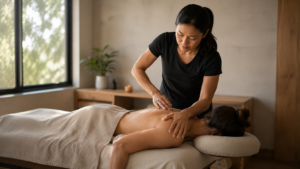
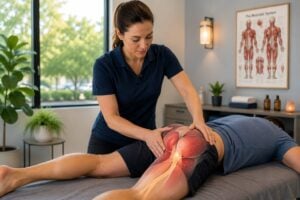
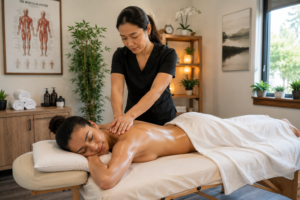
Treatment may involve the shoulder itself as well as related areas such as the upper back, neck, chest, shoulder blade, and arm.
Pressure should be adjusted to your comfort and condition.
A therapeutic session does not need to hurt intensely to be useful.
In fact, aggressively forcing painful tissue can increase guarding which is the exact response the therapist is trying to reduce.
Communication matters throughout the session. Sharp, electrical, burning, or otherwise concerning sensations should be reported immediately.
Afterward, the shoulder may feel different, but one session should not be treated as proof that an underlying injury has healed.
The more meaningful question is how your shoulder responds over time as massage is combined, when appropriate, with activity modification, exercise, rehabilitation, and medical guidance.
Supporting Your Shoulder Between Massage Sessions
What happens outside the treatment room matters.
If a repetitive activity continually overloads your shoulder, massage alone is unlikely to solve the problem.
Pay Attention to Repetitive Load
Consider what your shoulder does throughout a typical week.
Do you spend hours reaching overhead at work? Play several days of pickleball without recovery? Suddenly increase your weight-training volume? Carry a heavy bag on the same side every day?
Sometimes the problem is not one “bad” movement but the total amount of load the shoulder receives.
Follow Your Rehabilitation Plan
If a physical therapist or other qualified professional has prescribed exercises, consistency matters.
Exercise programs for rotator cuff-related shoulder pain often focus on gradually restoring strength, control, and mobility.
Massage can potentially complement that process, but it should not replace it.
Avoid Constantly Testing the Pain
When something hurts, people often check it repeatedly.
“Does it still hurt if I lift my arm now?”
Then they repeat the painful movement dozens of times throughout the day.
That constant testing can keep attention fixed on the irritated area. Follow the activity recommendations provided by your healthcare professional rather than repeatedly provoking symptoms just to see whether they remain.
Give Recovery Time
Musculoskeletal recovery is rarely perfectly linear.
A shoulder may feel excellent one day and irritated the next.
Sleep, workload, exercise, stress, and daily activity can all influence symptoms.
Look for trends in function over time rather than judging recovery by a single good or bad day.
Massage Therapy for Shoulder Pain in Pleasanton
Living with shoulder pain can affect far more than exercise.
It can change how you sleep, work, drive, dress, cook, lift your children, train at the gym, or participate in sports.
For people seeking massage for shoulder pain in Pleasanton, the most useful approach begins with understanding the individual and not applying the same routine to every painful shoulder.
At Narayan Wellness Inc., massage therapy can be tailored around muscular tension, movement limitations, activity demands, and the broader patterns surrounding shoulder discomfort.
Depending on the client’s needs and whether massage is appropriate, sessions may incorporate therapeutic massage, trigger point techniques, myofascial work, stretching, deep tissue techniques, or other bodywork approaches.
The objective is not to promise that massage can “heal” every rotator cuff injury.
Instead, massage can serve as one supportive tool for people working toward more comfortable movement, reduced muscular tension, and better function.
That distinction matters.
A rotator cuff tear may require medical care. Significant weakness needs appropriate evaluation. Rehabilitation often requires progressive exercise.
But when massage is appropriate, thoughtful therapeutic bodywork can address the muscles and compensation patterns that often accompany a painful shoulder.
The shoulder is not an isolated hinge. It is part of an interconnected movement system extending through the arm, shoulder blade, chest, upper back, and neck.
Supporting that entire system can make the recovery process feel less like fighting one painful spot and more like helping the body move together again.
FAQs
Can massage therapy help rotator cuff pain?
Massage therapy may help some people manage muscular tension, sensitivity, stiffness, and compensation patterns associated with shoulder pain. However, rotator cuff-related shoulder pain has many possible causes, so persistent or significant symptoms should be appropriately evaluated. Massage should be viewed as supportive care rather than a guaranteed treatment for the underlying injury.
Can massage heal a rotator cuff tear?
No. Massage cannot reconnect or structurally repair a torn rotator cuff tendon. Depending on the individual situation, massage may sometimes be used to address surrounding muscular tension as part of a broader care plan. A suspected or confirmed tear should be managed with guidance from an appropriate healthcare professional.
Is deep tissue massage good for rotator cuff pain?
It depends on the condition and stage of recovery. Deep tissue techniques may be appropriate for chronic muscular tension surrounding the shoulder, but aggressive pressure is not automatically beneficial and may be inappropriate during an acute injury. Massage pressure should be individualized.
Where do massage therapists work for rotator cuff pain?
Treatment may involve more than the painful area. Depending on the assessment, a therapist may address muscles around the shoulder blade, upper back, neck, chest, posterior shoulder, and upper arm. The exact approach should reflect the client’s symptoms and health history.
Should massage for shoulder pain hurt?
Massage does not need to be intensely painful to be effective. Pressure should remain appropriate for the client’s condition and tolerance. Sharp, electrical, burning, or concerning pain should be communicated to the therapist immediately.