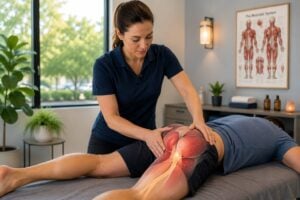
Most people have experienced them.
That stubborn knot in the shoulder that returns every few weeks. The tight spot between the shoulder blades that never fully relaxes. The neck tension that seems to reappear after every stressful workday.
You stretch. You foam roll. You use heating pads. Maybe you even get occasional massages.
Yet somehow, the tension keeps returning.
Why?
The answer is more complex than most people realize. Muscle knots are rarely caused by a single issue. They’re usually the result of layered physical, neurological, emotional, and lifestyle factors working together over time.
Understanding why muscle knots keep coming back is the first step toward real, lasting relief.
What Are Muscle Knots?
Although “muscle knot” isn’t a formal medical diagnosis, the term commonly refers to areas of tight, contracted muscle fibers known as trigger points.
These tight bands can:
- Feel tender or painful
- Restrict movement
- Cause stiffness
- Refer pain into other areas
- Create headaches or nerve irritation
- Reduce circulation
Imagine pulling one tiny section of a sweater too tightly. The tension spreads and affects the entire fabric. Muscles behave similarly.
When certain fibers remain contracted for too long, they create localized tension that disrupts normal movement and blood flow.
Over time, this creates a cycle:
- Tightness limits circulation
- Reduced circulation decreases oxygen delivery
- The muscle becomes irritated and inflamed
- The nervous system maintains protective tension
- The knot persists or worsens
This is why muscle knots often feel “stuck.”
Why Muscle Knots Keep Coming Back
Temporary relief is common. Permanent resolution is harder.
That’s because recurring muscle knots are usually symptoms of deeper dysfunction rather than isolated muscular problems.
Here are the most common hidden causes.
The Connection Between Stress and Chronic Tension
Your body stores stress physically.
When the nervous system perceives emotional stress, it activates the body’s fight-or-flight response. Stress hormones like cortisol and adrenaline increase muscle guarding and tension patterns.
For many people, this tension settles into predictable areas:
- Neck
- Shoulders
- Jaw
- Upper back
- Hips
Think about what happens during a stressful meeting. Your shoulders rise. Your jaw tightens. Your breathing becomes shallow.
Now imagine repeating that pattern every day for months or years.
Eventually, the body forgets how to fully relax.
Chronic stress essentially teaches muscles to remain partially contracted even when danger is gone.
This is one reason recurring knots are so common among:
- Busy professionals
- Caregivers
- Students
- Athletes under pressure
- Individuals experiencing anxiety or burnout
Massage therapy can help interrupt this stress-tension cycle by activating the parasympathetic nervous system which is the body’s natural rest-and-recovery mode.
This creates both muscular and neurological relaxation simultaneously.
How Poor Posture Creates Persistent Knots
Modern posture habits are one of the biggest contributors to chronic muscle tension.
Hours spent:
- Looking down at phones
- Sitting at desks
- Driving
- Working on laptops
- Slouching on couches
…all force certain muscles to overwork continuously.
For example:
- Forward head posture strains neck muscles
- Rounded shoulders overload the upper back
- Weak core muscles shift tension into the lower back
- Hip compression shortens surrounding muscles
The body compensates constantly to keep you upright.
Over time, these compensation patterns create recurring knots because the muscles never fully rest.
This explains why many people feel temporary relief after massage, but the tension returns once they resume the same posture habits.
Without addressing the underlying mechanical stress, the body simply recreates the pattern.
Fascia, Movement Patterns, and Muscle Adhesions
Muscles don’t work alone.
They’re surrounded by fascia which is a connective tissue network that supports movement throughout the entire body.
Healthy fascia is flexible and hydrated.
But injury, repetitive strain, inactivity, inflammation, or stress can cause fascia to stiffen and adhere to surrounding tissues.
This creates:
- Restricted mobility
- Pulling sensations
- Compensatory movement
- Chronic tightness
- Persistent trigger points
Imagine wearing a tight sweater several sizes too small. Every movement feels restricted.
That’s how dysfunctional fascia can affect the body.
This is why muscle knots sometimes appear far from the true source of dysfunction.
For example:
- Tight hips can contribute to shoulder tension
- Foot instability may affect the lower back
- Jaw clenching can trigger neck pain
The body functions as an interconnected system.
Skilled massage therapy focuses not only on the painful area but also on the surrounding movement patterns contributing to the problem.
Why Stretching Alone Often Doesn’t Work
Stretching has benefits.
But many people rely on stretching alone while ignoring the deeper causes of recurring tension.
Here’s the problem:
A muscle that feels tight is not always truly “short.”
Sometimes it’s:
- Weak
- Overcompensating
- Neurologically guarded
- Inflamed
- Restricted by fascia
- Fatigued from repetitive use
Aggressively stretching these tissues without addressing the underlying dysfunction may provide temporary relief but rarely solves the issue long-term.
This is why some people stretch daily and still feel chronically tight.
The body often needs:
- Tissue release
- Nervous system regulation
- Improved circulation
- Movement retraining
- Stress reduction
- Strength balance
Massage therapy helps address several of these layers simultaneously.
How Massage Therapy Breaks the Cycle
Massage therapy does far more than simply “relax muscles.”
Therapeutic bodywork affects:
- Muscles
- Fascia
- Circulation
- Nervous system activity
- Pain signaling
- Joint mobility
- Stress hormones
This multi-system effect is what makes massage especially valuable for recurring muscle knots.
Improved Blood Flow
Tight muscles often receive poor circulation.
Massage increases blood flow, helping deliver:
- Oxygen
- Nutrients
- Anti-inflammatory compounds
Better circulation supports tissue repair and reduces irritation.
Trigger Point Release
Targeted pressure techniques help deactivate hyperirritable trigger points within the muscle.
This can:
- Reduce referred pain
- Improve range of motion
- Decrease muscle guarding
- Restore normal muscle function
Trigger point therapy is particularly effective for chronic neck and shoulder tension.
Nervous System Regulation
One of the most overlooked aspects of chronic tension is nervous system involvement.
When the body stays in a prolonged stress response, muscles remain partially activated.
Massage therapy encourages parasympathetic activation, helping the body shift out of survival mode.
This creates deeper, more sustainable relaxation than stretching alone.
Fascia Mobilization
Techniques like myofascial release help improve tissue glide and reduce restrictions within connective tissue.
This improves:
- Mobility
- Flexibility
- Movement efficiency
- Pain reduction
Healthy fascia allows muscles to move with less strain and compensation.
Types of Massage That Help Chronic Muscle Tension
Different forms of massage therapy target recurring knots in different ways.
Deep Tissue Massage
Deep tissue massage uses slower, sustained pressure to address deeper muscular layers and chronic adhesions.
It’s especially useful for:
- Long-standing tension
- Postural strain
- Athletic overuse
- Restricted mobility
Trigger Point Therapy
This technique focuses directly on hyperirritable muscle bands responsible for referred pain patterns.
It’s highly effective for:
- Shoulder knots
- Tension headaches
- Jaw pain
- Hip tightness
Myofascial Release
Myofascial techniques focus on connective tissue restrictions rather than forceful pressure.
This can help:
- Improve mobility
- Reduce chronic pulling sensations
- Restore tissue elasticity
Relaxation Massage
Not all chronic tension requires intense pressure.
For stress-driven muscle guarding, relaxation massage may help calm the nervous system and reduce baseline muscular tension patterns.
Lifestyle Habits That Prevent Muscle Knots
Massage therapy works best when paired with supportive daily habits.
Small changes often create significant long-term improvements.
Improve Ergonomics
Adjust:
- Screen height
- Chair support
- Keyboard placement
- Desk posture
Even subtle posture improvements reduce repetitive muscular overload.
Move More Frequently
The body dislikes prolonged stillness.
Short movement breaks every 30–60 minutes help:
- Restore circulation
- Reduce stiffness
- Prevent muscular fatigue
Simple walking and mobility exercises can make a major difference.
Manage Stress Proactively
Stress management isn’t optional when addressing recurring muscle tension.
Helpful strategies include:
- Breathwork
- Meditation
- Exercise
- Sleep optimization
- Massage therapy
- Mindfulness practices
The calmer the nervous system becomes, the less muscular guarding occurs.
Stay Hydrated
Hydration supports tissue elasticity and fascia health.
Dehydrated tissues often feel stiffer and less resilient.
Strengthen Weak Muscles
Sometimes tight muscles are overworking because neighboring muscles are weak.
Balanced strength training can reduce chronic compensation patterns and improve posture.
When Muscle Knots Signal a Bigger Problem
Most muscle knots are benign.
However, persistent or worsening tension should sometimes be professionally evaluated especially when accompanied by:
- Numbness
- Tingling
- Sharp pain
- Weakness
- Severe headaches
- Radiating symptoms
- Loss of mobility
These symptoms may involve:
- Nerve compression
- Joint dysfunction
- Disc issues
- Systemic inflammation
- Underlying medical conditions
A qualified healthcare provider can help determine whether additional treatment is needed.
Massage therapy often works best as part of a comprehensive wellness approach.
How Consistent Therapy Supports Long-Term Relief
One massage may help temporarily.
Consistent care helps retrain long-standing patterns.
Think of chronic tension like repeatedly bending a paperclip. Over time, the body adapts to stress patterns and compensation habits.
Sustainable improvement often requires:
- Repetition
- Nervous system recalibration
- Tissue remodeling
- Improved movement awareness
Regular massage therapy may help:
- Reduce tension frequency
- Improve mobility
- Decrease stress accumulation
- Prevent flare-ups
- Support recovery from daily strain
For many people, maintenance sessions become part of a proactive wellness routine rather than a reaction to severe pain.
Final Thoughts
Recurring muscle knots are rarely random.
They’re usually signals from the body that something deeper needs attention, whether it’s stress overload, poor posture, movement dysfunction, fascia restriction, or chronic nervous system tension.
Temporary relief matters, but understanding why muscle knots keep coming back creates the opportunity for lasting change.
Massage therapy helps address the problem from multiple angles:
- Releasing tight tissues
- Improving circulation
- Calming the nervous system
- Supporting mobility
- Reducing compensation patterns
When combined with healthy movement, stress management, and consistent care, therapeutic massage can help break the cycle of chronic tension and restore a greater sense of comfort, balance, and physical freedom.
FAQs
Why do muscle knots keep returning?
Muscle knots often return because the underlying causes — such as stress, poor posture, repetitive movement, weak muscles, or fascia restrictions — haven’t been fully addressed.
Can massage therapy permanently remove muscle knots?
Massage therapy can significantly reduce and manage muscle knots, especially when combined with posture correction, movement improvements, stress management, and regular maintenance care.
What type of massage is best for muscle knots?
Deep tissue massage, trigger point therapy, and myofascial release are commonly used to address chronic muscle tension and recurring trigger points.
Are muscle knots caused by stress?
Yes. Chronic stress activates the nervous system and can cause muscles to remain partially contracted, leading to tension and trigger point formation.
How often should you get massage therapy for chronic tension?
Frequency depends on severity, stress levels, posture habits, and activity level. Many people benefit from consistent sessions every 2–4 weeks for maintenance and prevention.