What Is Scar Tissue?
Scar tissue is the body’s natural repair patch.
Whenever you experience a cut, surgery, muscle tear, ligament sprain, or deep bruise, your body produces collagen fibers to close and reinforce the injured area. Think of it like emergency scaffolding. The goal isn’t perfection, it’s protection.
But here’s the catch:
Scar tissue doesn’t rebuild in the same organized pattern as the original tissue. Instead of neat, parallel fibers that allow smooth movement, scar tissue forms in a dense, crisscrossed pattern. It’s stronger in some ways, but far less flexible.
That’s where scar tissue massage becomes essential.
Without proper remodeling, scar tissue can:
- Restrict range of motion
- Cause stiffness
- Create pulling sensations
- Lead to chronic pain
- Interfere with athletic performance
- Contribute to postural imbalances
And these issues don’t always show up immediately. Sometimes they develop months, even years, later.
What Are Adhesions and Why Do They Form?
Adhesions are bands of scar tissue that bind together structures that are meant to move independently.
Imagine plastic wrap sticking two pieces of fabric together. That’s what adhesions do inside the body.
They can form:
- Between muscles
- Between muscle and fascia
- Around joints
- Between organs (after abdominal surgery)
- Around nerves
After surgery or injury, inflammation increases fluid and collagen production. If movement is limited, which often happens during recovery, those fibers settle in sticky, restrictive patterns.
Over time, adhesions can:
- Reduce mobility
- Create abnormal tension patterns
- Cause compensatory movement
- Trigger secondary pain in other areas
This is why post-surgical stiffness often doesn’t stay local. A knee surgery, for example, can eventually affect hip and low back mechanics.
The Hidden Problem: How Scar Tissue Restricts Movement
Healthy tissue glides. Scar tissue grips.
Muscles are designed to slide over one another. Fascia, the connective web surrounding muscles, should glide smoothly during movement.
When adhesions form, glide turns into drag.
This restriction can:
- Limit joint mobility
- Alter gait
- Reduce flexibility
- Decrease strength efficiency
- Increase risk of re-injury
Athletes often describe it as “tightness that stretching won’t fix.” That’s because stretching lengthens muscle fibers, but it doesn’t necessarily break up adhesions.
Breaking up adhesions massage techniques specifically target those dense collagen cross-links.
Why Scar Tissue Can Cause Pain Months (or Years) Later
Pain doesn’t always come from the injury itself.
Sometimes it comes from how the tissue healed.
Scar tissue can:
- Compress nearby nerves
- Alter biomechanics
- Create uneven load distribution
- Restrict circulation
- Reduce lymphatic flow
Over time, the body compensates. Other muscles work harder. Joints absorb stress differently.
Eventually, discomfort shows up in unexpected places.
For example:
- An old ankle sprain may contribute to knee pain.
- A C-section scar can affect core engagement.
- Shoulder surgery may limit overhead mobility long after healing.
Addressing scar tissue pain relief early prevents these long-term patterns.
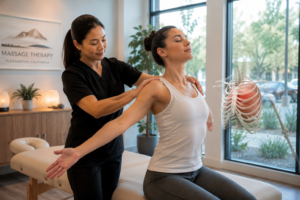
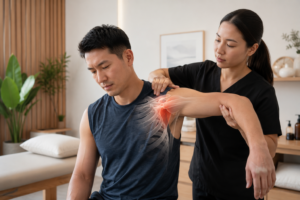
How Scar Tissue Massage Works
Scar tissue massage works by mechanically remodeling collagen fibers.
When applied with precision and appropriate pressure, massage therapy can:
- Stimulate circulation
- Increase tissue temperature
- Encourage collagen realignment
- Improve tissue glide
- Reduce nerve sensitivity
- Restore functional movement
This process is sometimes called “tissue remodeling.”
The goal isn’t to erase scar tissue, that’s impossible. Instead, the goal is to make it more pliable, flexible, and integrated with surrounding structures.
Deep tissue massage for scar tissue often incorporates slow, deliberate strokes applied perpendicular to the scar line. This helps reorganize collagen fibers and reduce adhesions.
When to Start Massage After Surgery or Injury
Timing matters.
In general:
- Immediately after injury: Focus is on reducing inflammation.
- Once incision is fully closed: Gentle scar mobilization may begin (with physician approval).
- 6–8 weeks post-surgery: Deeper work may be appropriate, depending on healing.
Always consult your surgeon or physician before beginning post-surgical massage therapy.
Starting too early can disrupt healing. Starting too late can allow adhesions to become more established.
An experienced therapeutic massage provider will assess tissue quality, healing stage, and pain sensitivity before beginning treatment.
Signs You May Need Scar Tissue Treatment
You may benefit from scar tissue massage if you notice:
- Persistent tightness around a surgical site
- Pulling sensations with movement
- Numbness or tingling near scar tissue
- Reduced range of motion
- Ongoing pain months after healing
- Visible thickening or raised scar texture
- Compensatory pain elsewhere
Even small scars can cause big problems internally. The surface appearance doesn’t always reflect the depth of restriction underneath.
Techniques Used in Scar Tissue Massage Therapy
Effective scar tissue treatment often combines several advanced techniques.
1. Cross-Fiber Friction
Applies pressure perpendicular to tissue fibers to encourage collagen remodeling.
2. Myofascial Release
Targets fascial restrictions and improves glide between tissue layers.
3. Trigger Point Therapy
Addresses secondary muscle tension caused by altered biomechanics.
4. Neuromuscular Therapy
Helps restore proper nerve-muscle communication patterns.
5. Cupping (When Appropriate)
May assist with decompression and improved circulation.
Each treatment plan is customized based on:
- Type of surgery or injury
- Location of scar
- Age of scar tissue
- Pain levels
- Mobility restrictions
The Role of Fascia in Adhesions and Mobility
Fascia is the connective tissue web that surrounds every muscle, bone, nerve, and organ.
When fascia becomes restricted, it can transmit tension across the body.
Think of fascia like a sweater. Pull one thread, and tension spreads throughout the fabric.
Scar tissue within fascia can:
- Limit overall flexibility
- Reduce coordinated movement
- Increase stiffness in distant areas
Addressing fascia is crucial in adhesion therapy because mobility restoration requires full-system integration, not just local treatment.
Scar Tissue Massage for Different Types of Surgeries & Injuries
Scar tissue massage can benefit individuals recovering from:
- Orthopedic surgeries (knee, hip, shoulder)
- C-sections
- Abdominal surgeries
- Rotator cuff repairs
- ACL reconstruction
- Joint replacements
- Tendon repairs
- Sports injuries
- Severe muscle strains
- Fractures
Each requires a slightly different approach.
For example:
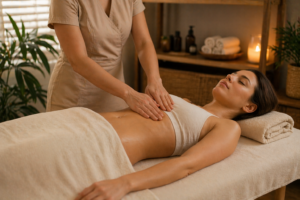
Abdominal scars require gentle, layered work due to underlying organ proximity.
Joint surgeries may require coordinated mobility exercises.
Athletic injuries often need integration with strength training.
What to Expect During a Scar Tissue Massage Session
Your first session typically includes:
- Health history review
- Surgical or injury timeline discussion
- Range of motion assessment
- Palpation of scar and surrounding tissue
- Gradual introduction of targeted techniques
Scar tissue work may feel:
- Intense but controlled
- Deep but not sharp
- Focused rather than relaxing
Mild soreness afterward is common and usually resolves within 24–48 hours.
Hydration and gentle movement afterward support recovery.
How Many Sessions Are Needed?
It depends on:
- Age of the scar
- Severity of adhesions
- Location
- Activity level
- Healing quality
Recent scars may respond within a few sessions.
Older, established adhesions may require consistent treatment over several weeks.
The key is progressive improvement in mobility and reduction in discomfort.
Risks, Safety, and When to Avoid Treatment
Scar tissue massage is generally safe when performed by a trained professional.
Avoid treatment if you have:
- Open wounds
- Active infection
- Blood clots
- Unhealed surgical incisions
- Certain inflammatory conditions (unless cleared by physician)
A qualified therapist will screen for contraindications.
At-Home Scar Tissue Mobility Strategies
Professional care is most effective, but you can support healing with:
- Gentle scar mobilization (once healed)
- Light stretching
- Hydration
- Anti-inflammatory nutrition
- Movement-based rehabilitation exercises
However, self-treatment has limits. Deep adhesions often require skilled hands and advanced technique.
Why Professional Therapeutic Massage Makes a Difference
Scar tissue remodeling is not simply about pressure.
It requires:
- Anatomical precision
- Understanding of healing timelines
- Knowledge of contraindications
- Experience with post-surgical care
- Integration with overall movement patterns
Working with a trained therapeutic massage professional ensures safe, effective progress.
For residents seeking scar tissue treatment in Pleasanton, professional care can mean the difference between temporary relief and lasting mobility restoration.
Restoring Movement and Confidence After Injury
Injury can make you feel disconnected from your body.
Stiffness lingers. Movement feels guarded. You hesitate before certain activities.
But your body is adaptable.
With the right intervention, scar tissue can become more flexible. Adhesions can soften. Mobility can improve.
Scar tissue massage helps restore not just movement but confidence.
When tissues glide freely again, your body moves the way it was designed to.
And that’s when healing truly feels complete.
FAQs
When should I start scar tissue massage after surgery?
Typically after the incision is fully healed and with physician approval — often around 6–8 weeks post-surgery.
Can massage really break up adhesions?
Massage helps remodel collagen fibers and improve tissue glide, reducing restriction and pain over time.
Is scar tissue massage painful?
It may feel intense, but it should not feel sharp or unbearable. Communication with your therapist is key.
Can old scars still be treated?
Yes. Even years-old scars can benefit from adhesion therapy and mobility-focused massage.
How many sessions do I need?
It depends on scar age and severity. Some clients see improvement within a few sessions, others require ongoing care.